Afternoon Surplus, Evening Deficit: Sizing a Home Battery for Real UK Consumption
Photo: iSys.PL, Attribution, via Wikimedia Commons
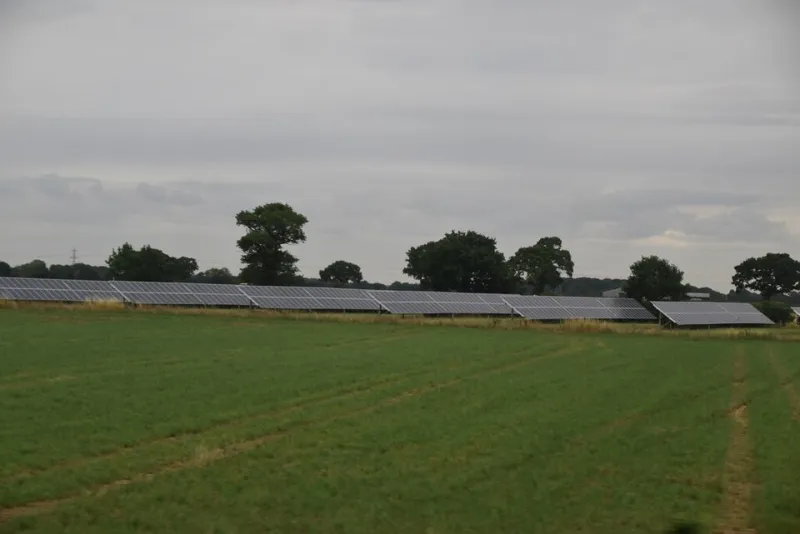
Solar panels are often sold on annual yield. A household's smart meter tells a more useful story: generation and consumption are badly matched on most days, and the mismatch is sharpest in the late afternoon. As UK homes electrify heating and transport, that timing matters more than the headline kilowatt-peak figure.
The shape of the problem
On a bright day a south-facing array may produce most of its output between 10am and 3pm. Household demand often peaks after 4pm, when lights, cooking, heat pumps and electric vehicle charging converge. In winter the solar window is shorter and the evening peak falls in darkness. Smart meter data recorded at half-hourly intervals exposes this clearly: exports cluster around midday, imports around the evening peak.
Annual totals can hide the issue. A 4 kWp array might generate 3,600 kWh over a year, but much of that arrives when nobody is home. If the household exports 1,800 kWh at 5p per kWh and later buys 1,800 kWh at 26p, the financial loss is obvious. A battery can narrow that gap, but only by the amount it can store, discharge and cycle economically.
Three prices decide the case
A home battery is an arbitrage device. Its value depends on the price of imported electricity it avoids, the export payment it forgoes and the round-trip losses it incurs. Under the Smart Export Guarantee, export rates vary by supplier and tariff. Some time-of-use tariffs offer much higher evening import prices and cheaper overnight windows; others offer generous export rates that make storing solar less attractive.
A simple test helps. If the avoided import price is 28p per kWh, the forgone export rate is 8p and the battery round-trip efficiency is 90%, the value of each stored kilowatt-hour is roughly 28p minus 8p, adjusted for losses. That is about 18p per usable kWh before accounting for degradation and finance. Multiply by realistic annual cycles, not laboratory cycles, and compare with installed cost. If the number is thin, the battery is a lifestyle purchase rather than an investment.
Why some systems become expensive hobbies
A battery becomes an expensive hobby when it is sized for a sunny day rather than an evening load. Oversized batteries sit full for long periods, lose charge to standby consumption and rarely reach their warranted cycle life. Small batteries can be equally poor value if they cannot absorb the midday surplus or cover the evening peak. Inverter limits, export restrictions and a lack of space for additional units also matter.
Households with low evening demand, a high export rate or a short remaining tariff window may find that exporting solar and importing later is cheaper than storage. Households that add a heat pump or electric vehicle often see the case improve, because those loads can be shifted into the solar window or the battery can discharge into a genuinely expensive peak.
What to check before buying
Start with data, not a quotation. Download half-hourly consumption and generation data from the supplier or monitoring platform, then model a typical week in March and October as well as midsummer. Look at the evening peak, the midday export and the annual total. Ask the installer to show the assumed cycles, depth of discharge, round-trip efficiency and warranty conditions.
Check the commercial detail too: whether the battery is AC- or DC-coupled, whether it can operate during a power cut, how it interacts with the existing inverter, and what grid notification is required. Confirm insurance, fire safety and location requirements. A battery is not a substitute for fabric efficiency: insulation, draught-proofing and heating controls still reduce the load that must be met.
The sensible conclusion
For a UK home with a solar array, a heat pump or an electric vehicle, and a tariff with a meaningful evening peak, a well-sized battery can turn an awkward generation profile into useful evening supply. For a low-use household on a flat tariff with a decent export rate, it may be an expensive way to store a modest amount of energy. The smart meter does not lie. Read it before signing.